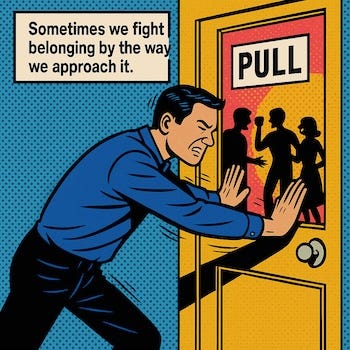
The Commitment to Outsiderness
When outsiderness becomes an identity pillar

Outsider syndrome isn’t always about what they do. Sometimes, it’s about what we do.
Because here’s the truth: even when belonging is offered, some of us can’t take it in. Outsiderhood feels safer. It becomes familiar. Predictable. Over time, it can even become who we believe ourselves to be.
My Early Outsider Story
I know this story well.
I grew up as the child of an immigrant, with a face and a body that told a story before I ever opened my mouth. Half Asian, half white — never “enough” of either to blend in seamlessly. I was born with a birth defect, which meant summers weren’t for camp or sleepovers but for hospitals and surgeries. While other kids were forming bonds over shared adventures, I was learning what it meant to be set apart.
The lesson sank deep: I was different. I was weird. I was outside.
And eventually, I made a commitment to it. Outsiderhood became safer than belonging. Because if I never counted myself in, I couldn’t be hurt by being pushed out.
The Workplace Realization
That commitment didn’t stay in childhood — it followed me into my career.
A few years ago, I found myself in tough spot. I was struggling with new leadership on my team. I felt like they hated me, wanted me out, were against me. I didn’t trust them. Every interaction felt like proof that I didn’t belong. It was a horrible way to exist. A senior leader stepped in and was kind enough to listen to me vent about feeling ostracized. She listened with curiosity and not judgment and then asked me directly, but gently:
“Are you sure you’re open to belonging?”
The question was a doozy. It pained me to admit it, but she might have been right. My commitment to outsiderness was keeping me completely closed to any other possibility. It wasn’t a fairy tale from there — this is corporate America, not Neverland. But that question has stuck with me for years and it sent me on a quest to work on opening up my capacity to belong.
The Gifts and the Costs
That outsider stance gave me gifts: self-awareness, analytical sharpness, adaptability. But it also carried costs. Outsiderhood wasn’t just a circumstance anymore — it was an identity. And that identity meant I sometimes rejected belonging even when it was being offered.
Why DEI Alone Isn’t Enough
This is why systemic belonging initiatives, as critical as they are, can only do so much. You can build inclusive spaces. You can send all the right signals. But if someone is committed to outsiderness inside themselves, they may not feel the safety of belonging, no matter how wide you open the circle.
The Question of Safety
Why cling to outsiderhood? Because it’s known. Because it hurts less to stand apart on purpose than to risk stepping in and being turned away. For those of us who have carried long histories of exclusion, belonging feels more dangerous than isolation.
And so the work becomes less about forcing belonging and more about building the capacity for it — expanding the part of us that can tolerate the risk of acceptance, that can let the warmth in without bracing for it to vanish.
Key Takeaways
Outsiderhood can become an identity, not just a circumstance.
That identity brings both strengths and costs.
External inclusion is essential, but it cannot override an internal commitment to outsiderness.
The work of belonging is learning to risk safety in connection.
Reflection + Action
Where do you hold yourself outside, even when belonging is offered?
What gifts has outsiderhood given you?
What cost has it carried?
What small experiment could you try this week to soften the outsider stance — just enough to notice what belonging might feel like in your body?
👉 Next week, we’ll explore exactly that: how to build the capacity for belonging so we can risk stepping inside without losing ourselves.